


Reading sunglasses 3.5 can make outdoor shopping, menus, and close-up tasks easier, but the number on the frame is only one part of choosing a comfortable pair. You also need to compare sun coverage, UV protection, glare control, lens format, and how comfortably the frame stays in place.
Browse SAV sunglass readers and find your power
That distinction helps you avoid choosing a strong reader based on appearance alone. First, clarify what +3.50 means and how it relates to the close-up distance you need to see clearly.
What Does +3.50 Mean in Reading Sunglasses?
For shoppers comparing reading sunglasses 3.5, +3.50 identifies the lenses' reading magnification, not their tint, coverage, or polarization. Confirm the exact power and sun-related features on the individual product page before you buy.
When you see +3.50 on a pair of reading sunglasses, the number describes the lens magnification power. It is the strength intended to make close-up details easier to see, not a rating for the lens tint, frame color, or ultraviolet protection. In other words, +3.50 answers the question, "How much magnification does this lens provide?" It does not answer whether the sunglasses are dark enough for bright conditions or whether they include UV protection. Those are separate product details to check before you buy.
A +3.50 power is generally positioned toward the stronger end of common over-the-counter reading magnifications. Retailers may label the category as 3.50 reading glasses or show +3.50 as a selectable shopping filter. For example, reading-glasses collections identify +3.50 as a distinct power category, while sunglass-reader catalogs may let shoppers select 3.50 before adding a frame to the cart. That shopping label helps you compare products, but it should not be treated as a guarantee that every frame in a collection is available in that power.
The clearest way to shop for reading sunglasses 3.5 is to separate the decision into two checks. First, confirm that the individual product offers +3.50 or 3.5 as a selectable power. Second, review the same product page for its lens format and sun-related specifications. A magnification number alone does not tell you whether the reader portion covers the full lens or occupies only part of it. It also does not confirm tint, UV protection, polarization, or glare control.
Is +3.50 the same as 3.5?
Yes. The plus sign and decimal format are simply two ways of displaying the same reading power. A listing may show +3.50, 3.50, or 3.5, depending on the retailer's product selector. Look for the exact power option on the product page rather than relying only on a collection headline or a product photograph. If the selector does not show the power you need, do not assume it can be supplied after checkout.
Who may shop for this strength?
Shoppers who need stronger close-up magnification may compare +3.50 reading sunglasses for reading menus, checking a phone, reviewing labels, or handling other nearby tasks outdoors. The right choice still depends on your usual working distance and how your current readers perform. If +3.50 feels too strong, too weak, or suddenly different from the power you normally use, pause before purchasing and consider getting your vision needs checked by an eye-care professional.
The practical takeaway is simple: +3.50 tells you the magnification strength, while the rest of the product page tells you what kind of sunglass reader it is. Confirm the power first, then compare the frame and lens features that match how you plan to use it.
Which Lens Format Works Best for Reading Sunglasses 3.5?
For +3.50 outdoor reading, fully magnified lenses keep near power across the lens, bifocals place it in a lower zone, and progressive designs transition across distances. Choose based on how often you switch between close tasks and ordinary outdoor viewing.
When shopping for strong reading sunglasses, the lens format matters as much as the magnification label. A +3.50 power tells you the strength of the close-up correction, but it does not tell you where that magnification appears across the lens. Fully magnified, bifocal, and progressive designs place the reading power differently. So the best choice depends on whether you spend most of your time looking down at a book, glancing between near and far, or moving between several distances outdoors.
Reading sunglasses combine tinted sunglass lenses with a reader function. For a quick overview of what sunglass reading glasses are, start with the basic distinction: the sun lens handles outdoor brightness and tint, while the magnified area helps with close-up tasks. Those functions work together, but they are separate product attributes.
| Lens format | Where the magnification appears | Best fit for | Practical trade-off |
|---|---|---|---|
| Fully magnified | Across the entire lens. | Reading a menu, map, label, or book held at a consistent close distance. | Near clarity is available throughout the lens, but distant viewing may feel less natural. |
| Bifocal | In a defined lower reading area, with sunglass viewing above. | Switching between a phone or printed page and the path, scenery, or conversation. | Easy near-to-far access, although the boundary can take a little getting used to. |
| Progressive or multifocal | Through a gradual range of powers from upper to lower lens areas. | Moving between distance, intermediate tasks, and close reading during active days. | Smooth transitions without a visible line, but the usable zones require more precise positioning. |
When is a fully magnified format the simplest choice?
Choose a fully magnified format when your main outdoor task is close-up and your viewing distance stays fairly consistent. It can be practical for reading a paperback on a sunny patio, checking a phone while seated, or studying a menu at an outdoor cafe. Because the full lens carries the same reading power, you do not need to move your gaze toward a particular lower section. The trade-off is that looking across a landscape or walking around may not feel as seamless as it does with a dedicated distance lens above the reading area.
Why choose bifocal reading sunglasses?
Bifocal sunglasses are useful when you repeatedly alternate between near and far. The upper portion remains a sunglass lens for ordinary outdoor viewing, while the lower portion supplies the reader power for a phone, map, fishing line, or printed instructions. This format keeps the magnification available without covering the entire visual field. SAV's SSR03 product page, for example, describes an invisible bifocal with the reader portion at the bottom and the sunglass portion above. Confirm the exact power and specifications on the individual listing before adding a pair to your cart.
Who benefits from a progressive or multifocal format?
Progressive or multifocal lenses suit shoppers who want more than a simple near-versus-far switch. The gradual change can support distance viewing, an intermediate dashboard or tablet, and close reading in one design. That flexibility is especially relevant for travel, outdoor events, or active days when your gaze changes often. However, progressive formats may take more practice because small shifts in head position can change which power zone you are using. If your priority is a clearly defined reading area and straightforward use, a bifocal may feel more intuitive. If you need magnification across the whole lens for one close task, fully magnified lenses may be the better match.
Before choosing reading sunglasses 3.5, decide how often you shift between distances, where you want the magnification, and whether you prefer a visible or invisible transition. Then review the product page for the specific power, lens format, tint, and protection claims rather than assuming every style offers the same combination.
How Can You Check UV Protection and Coverage?
Check the individual listing for a clear UVA and UVB protection statement, then assess how securely the frame fits and how much side light can enter. Tint and polarization are separate features, so do not infer either one from a dark lens or a +3.50 label.
When comparing reading sunglasses 3.5, treat UV protection and magnification as separate checks. The +3.50 label describes the lens power used for close-up viewing. It does not, by itself, tell you how well the frame blocks ultraviolet light, how much glare it reduces, or how much light can enter around the lenses. Read the product specifications for each pair before you buy.
Ultraviolet light is invisible electromagnetic radiation. The National Eye Institute explains that UVA wavelengths range from 315 to 400 nanometers, while UVB wavelengths range from 280 to 315 nanometers. Both matter when you are choosing sunglasses for outdoor use, because UV rays can damage the eyes. The institute also notes that UV light can penetrate eye tissues more easily than visible light. Read its guidance on protecting your eyes from the sun's UV light for the underlying safety information.

Look for a clear UVA and UVB statement
A dark tint is not a substitute for a stated UV-protection specification. Start by looking for language that clearly addresses both UVA and UVB protection. If a listing only describes the color or darkness of the lens, keep checking the specifications rather than assuming the tint provides complete coverage. The UV index can also be high on cloudy days, so sunglasses are not only for intensely sunny afternoons. Wearing sunglasses with a hat is one of the simplest ways to reduce exposure.
Check fit and the amount of light entering around the frame
Coverage depends on more than the lens label. A pair that sits securely and fits well can help limit light entering around the lenses. Compare the frame shape with how you plan to use it. For walking, driving, travel, or reading outdoors, look for a fit that stays in place without leaving obvious gaps at the sides. Wraparound coverage may reduce side entry on some designs, but do not assume every curved or oversized frame has the same level of protection. Confirm the exact product details.
Related products

Elevate your outdoor experience with the Sportex Bifocal Sunglass Readers SPSR02 Crosshair, engineered for precision.
View product

Separate UV protection, tint, and glare reduction
Tint changes how bright the scene appears. Glare reduction addresses reflected light, such as brightness from pavement, water, or a windshield. UV protection concerns invisible ultraviolet wavelengths. These functions can overlap in a sunglass lens, but one should not be used as proof of another. Polarization, in particular, should be confirmed on the individual product or collection instead of being assumed from a general sunglass-reader description.
For a concrete, product-specific example, the SSR03 bifocal sunglass readers product page confirms 100% UVA/UVB protection and polycarbonate lenses. It also identifies the Daytona design as a bifocal format, with the reader portion at the bottom and the sunglass portion above it. Those are verified SSR03 details, not claims about every pair of reading sunglasses. If this example matches your use, review the live listing for its current power and other specifications before adding it to your cart.
Finally, compare the product page with your actual outdoor routine. Confirm the stated UV coverage, inspect the fit and side coverage, and then consider tint and glare separately. That sequence helps you choose a pair that supports both clear close-up viewing and comfortable time outside.
What Makes a Pair Comfortable for Long Outdoor Wear?
Comfort comes from a secure, balanced fit, suitable frame dimensions, and construction that matches your activity. Check the bridge, temples, lens width, weight, and any listed hinges or nose pads instead of choosing by frame appearance alone.
Comfort becomes more important when reading sunglasses stay on your face for a full drive, walk, round of golf, or afternoon outdoors. Start with the fit rather than the color. A frame that sits securely without pinching can make close-up tasks easier and reduce the temptation to remove your glasses every few minutes.
Check the frame width against your face. The temples should rest comfortably along the sides of your head, while the bridge should sit securely without leaving painful pressure marks. If the bridge is too wide, the glasses may slide when you look down. If it is too narrow, pressure can build across the nose. Lens coverage matters, too. Well-fitting sunglasses can help limit stray light around the lenses, but a larger frame is not automatically a better fit for every shopper.
Frame construction can also affect all-day wear. Spring hinges allow the temples to flex slightly when you put the glasses on or take them off. Flexible temples and adjustable nose pads can make fit more forgiving, while soft-touch finishes may feel smoother against the skin. SAV lists these as comfort-related features, but the exact construction varies by product, so review the individual listing before choosing a pair.
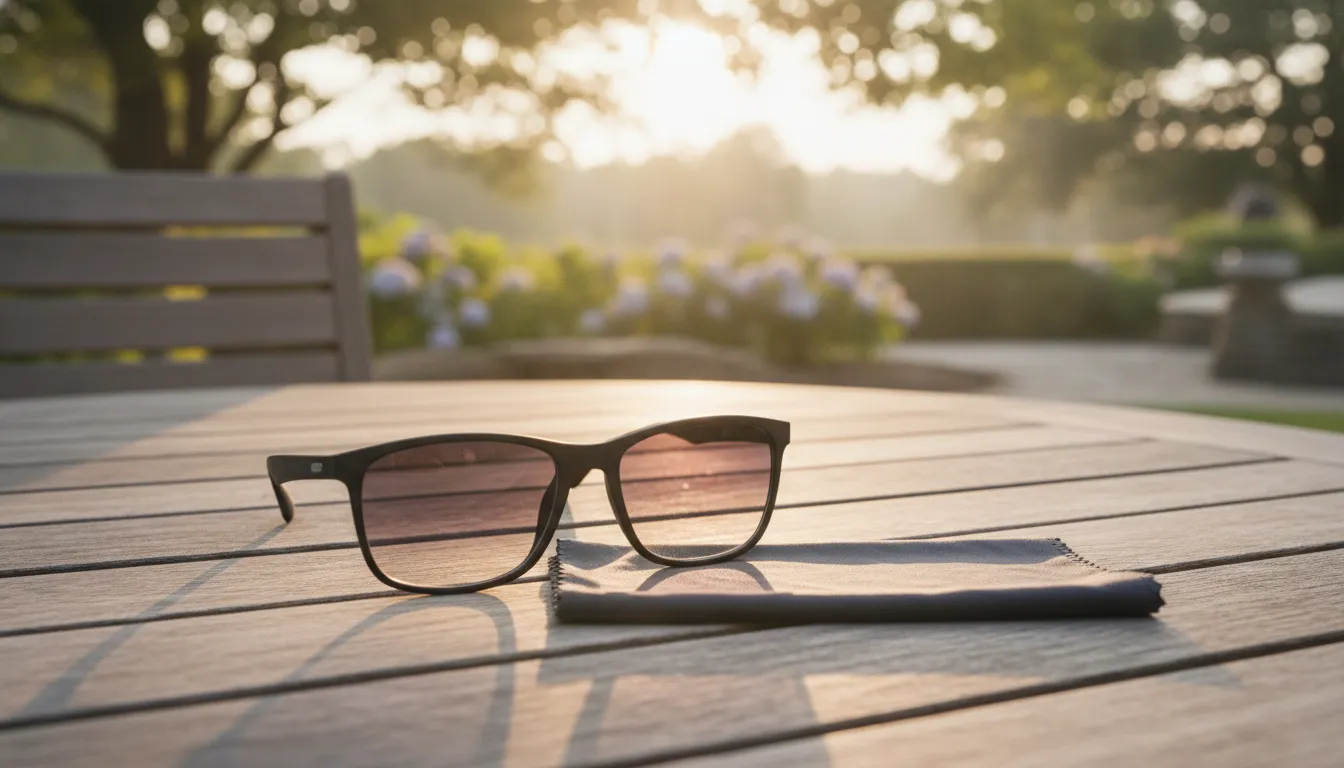
Material and weight should match the activity. Metal frames can offer a structured feel, while flexible materials may be useful when you want a more forgiving fit during travel or movement. For reading sunglasses used while walking or working outside, look for a pair that feels balanced on the bridge and does not slide when you turn your head. For more active use, consider sport-oriented designs intended to stay in place during motion. The best choice depends on whether your priority is relaxed everyday wear, driving, or higher-movement activities.
Glare control is a separate consideration from reading power and UV protection. Polarization may reduce reflected glare in bright conditions, but it is not a blanket feature across every pair. Confirm it on the specific product or collection page before buying. The same rule applies to lens material, protection claims, and frame measurements. For example, the SAV SSR03 listing identifies spring hinges, a metal frame, polycarbonate lenses, and a 59 mm lens width, giving shoppers concrete specifications to compare rather than assumptions to make.
Browse SAV sunglass readers to compare fit, features, and available powers.
When comparing reading sunglasses 3.5, treat comfort as a combination of measurements and intended use. Check the listed lens width, bridge and temple details when available, then consider whether the frame provides enough coverage for your outdoor routine. A comfortable pair should support the way you actually use it, not simply look good in a product photo.
How Do You Confirm the Right +3.50 Power Before Buying?
Use a current pair that gives you comfortable close-up vision as a starting point, match the lens to your working distance, and confirm +3.50 in the product selector. Then verify lens format, UV protection, fit, and return terms.
A strong magnification can be useful for close-up tasks, but the right choice depends on how you use your readers, how far away the task sits, and which lens format you select. Use this sequence before buying reading sunglasses 3.5, and treat the product page as the final source for the exact options and specifications.
- Start with the power you already use successfully. Check a current pair of reading glasses that gives you clear, comfortable close-up vision. If that pair is marked +3.50 and still works well for the task you have in mind, it gives you a practical starting point. SAV documents reading powers from +1.00 through +4.00, including +3.50, but availability and features can vary by individual product.
- Match the power to your working distance. Hold the book, menu, phone, craft project, or other item at the distance where you normally use it. A +3.50 lens is a magnification label, not a guarantee that every distance will look equally clear. If you need clarity at more than one distance, note that before choosing a fully magnified, bifocal, or progressive format.
- Check the selector before adding anything to your cart. On the product page, look for a power selector and choose +3.50 only when that option is visibly listed. Do not assume that a collection-level power range applies to every frame. SAV's shopping experience uses filters for magnification, style, and features, while the individual listing should confirm the exact product details. A product example such as SSR03 bifocal sunglass readers should be reviewed at the product level for its available choices, lens format, and specifications.
- Confirm where the magnification sits. Fully magnified lenses provide the reading power across the lens. Bifocal readers place the near-vision area in a defined lower portion, while progressive designs transition between distances. Select the format that matches your normal activity. If you look up often while walking, driving, or moving outdoors, make sure the format feels natural before relying on it for extended wear.
- Separate power from sun features. The +3.50 number describes magnification. Tint, coverage, polarization, and UVA/UVB protection are separate product attributes. Read the product description for each one instead of inferring them from the power, frame color, or collection name.
- Review the return terms and test the fit promptly. Before ordering, read the current return policy and any product-specific conditions. When the glasses arrive, check whether the frame sits securely, the reading area aligns with your normal task, and the chosen format feels comfortable. Keep the packaging and follow the stated return window if the fit or viewing experience is not right.
If your vision has changed, one eye sees differently from the other, or you cannot confirm a comfortable power with your current readers, pause before buying and consult an eye-care professional. A shopping guide can help you compare non-prescription options, but it cannot determine why your vision changed or replace an eye examination.
Where Should You Shop for Comfortable +3.50 Reading Sunglasses?
Start with a relevant sunglass-reader collection, then open individual product pages to confirm the +3.50 option, lens format, UV statement, frame measurements, and construction. Collection filters narrow the choice, but the product listing is the final check.
Once you know that +3.50 is the reading magnification you want, shop by the features that will matter in actual use. A strong pair of reading sunglasses should combine the right close-up power with a comfortable frame, useful lens coverage, and clearly stated sun-protection details. Do not treat a dark tint as proof of UV protection, or assume that every style in a collection has identical lens features.
Start with the SAV sunglass readers collection to compare the available styles and product-level information. SAV's catalog supports shopping by magnification, style, and features, which makes it easier to narrow a broad selection before you open individual listings. Look for a product that lets you select or confirm the power you need, then review its lens format. A fully magnified lens keeps the same reading power across the lens, while a bifocal style places the reading area lower for close tasks. That distinction can affect whether the glasses feel natural for reading a menu, checking a phone, or looking across a bright outdoor setting.
What should you verify on the product page?
Before adding a pair to your cart, confirm four details: the available power, the lens type, the stated UV protection, and the frame measurements. Product pages are the right place to check these specifications because collection-level descriptions should not be applied automatically to every style. Also review the listed dimensions and frame construction if you plan to wear the glasses for extended periods. Features such as spring hinges, flexible temples, or a comfortable bridge can make a greater difference than appearance alone.
If UV protection is a priority, compare a listing that states the feature directly, such as these sunglass readers with UV protection. Treat that product page as the source for its own specifications, not as a blanket claim about every reading-sunglasses option. If you need a different lens format, frame shape, or activity fit, return to the category and compare another verified listing rather than guessing from the photo.
Finally, consider how you will use the glasses. For occasional reading outdoors, a compact bifocal frame may be convenient. For longer periods in bright conditions, prioritize stable fit, adequate coverage, and specifications that match your needs. That focused checklist helps you shop reading sunglasses 3.5 with confidence without confusing magnification with the separate features that make a pair comfortable in the sun.
Shop +3.50 sunglass readers for your outdoor routine.
Frequently Asked Questions
Yes, +3.50 reading sunglasses are available, but the exact power and features vary by product. Confirm the selector, lens format, UV protection, tint, polarization, and fit on the individual listing before ordering.
Do they make reading sunglasses in a +3.50 power?
Yes. A +3.50 label identifies the lens magnification, and SAV documents reading-glass powers from +1.00 through +4.00, including +3.50. Check the individual sunglass-reader listing before buying because available powers can vary by product.
Are reading sunglasses 3.5 strong?
+3.50 is a relatively strong reading magnification compared with lower powers, but the right choice depends on your working distance and current readers. Use the power that gives you clear, comfortable close-up focus rather than choosing based on the number alone. If your usual power feels uncertain or your vision has changed, ask an eye-care professional before purchasing.
Can sunglasses also work as reading glasses?
Yes. Sunglass readers combine a tinted outdoor lens with a reading area or magnification. Fully magnified designs place the reading power across the lens, while bifocal and progressive formats position near vision in a specific zone. Choose the format that matches whether you read through the whole lens or mainly look down for close-up tasks.
Does +3.50 automatically mean the sunglasses are polarized or UV protective?
No. Reading power, tint, polarization, and UV protection are separate product attributes. Confirm each feature on the product page. For example, SAV's SSR03 listing specifically confirms 100% UVA/UVB protection, while polarization should only be assumed when the individual product or collection explicitly states it.
How do you choose comfortable reading sunglasses 3.5?
Confirm the +3.50 option, choose a lens format that matches how often you switch between distances, and compare UV protection, coverage, frame measurements, and fit on the individual product page.
Ready to Find Your +3.50 Sunglass Readers?
Use the checklist to compare available +3.50 powers, lens formats, UV protection, coverage, and frame comfort. The best pair is the one whose product details match your outdoor reading routine and whose fit feels secure for the way you will wear it.
Compare available powers and styles in one place, then choose a comfortable option for reading outdoors. Review the product details before adding a pair to your cart.